
TL;DR
- Most SME cashflow forecasts focus on sales and expenses but underweight timing risk from statutory obligations.
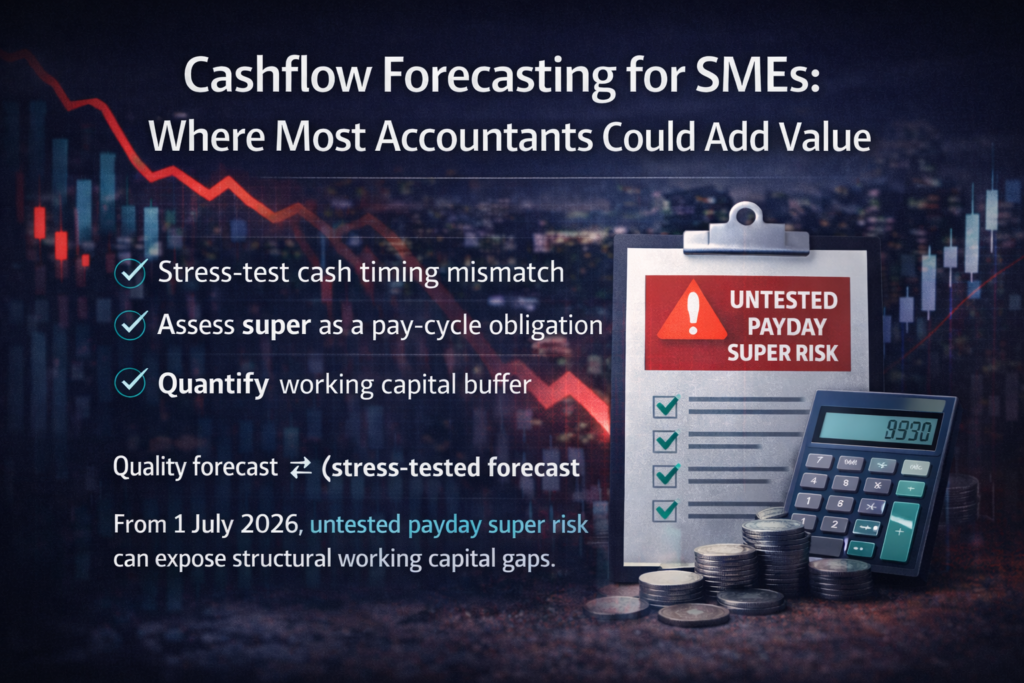
- From 1 July 2026, Payday Super requires super to be paid at the same time as wages, generally reaching the fund within 7 business days, which tightens pay-cycle cashflow timing.
- The common gap is not “forecasting skill”; it is failing to stress-test payroll-linked outflows against receivables timing.
- Accountants add disproportionate value by identifying timing mismatches early and triggering prevention actions before arrears.
- Use the Payday Super Calculator as the fastest stress test, then review facility structure if needed.
Run the Payday Super Calculator
Definition: What Is Cashflow Forecasting?
Cashflow forecasting is the process of predicting when cash enters and leaves the business over time. A useful forecast does not just estimate “how much” cash changes. It models “when” cash changes based on real payment timing.
Cashflow forecasting fails when timing assumptions are wrong, especially for:
- Receivables collection (who pays late, how often, and by how much)
- Payroll cycles (weekly/fortnightly outflows that do not move)
- Statutory payments (PAYG, GST, and super timing)
Definition: What Is Payday Super Timing Risk?
Payday Super timing risk is the increased liquidity pressure created when superannuation becomes a pay-cycle cashflow requirement rather than a periodic payment.
From 1 July 2026, employers must pay super at the same time as wages, generally ensuring it is received by the employee’s fund within 7 business days (with limited exceptions). Official ATO overview:
The Forecasting Gap: What Most SMEs Track vs What Actually Breaks Cashflow
Most SMEs forecast this:
- Sales growth
- Gross margin
- Overheads
- Large one-off expenses
What breaks cashflow is usually this:
- Receipts arrive later than assumed
- Payroll outflows happen exactly on schedule
- Super becomes a pay-cycle outflow (not a quarterly event)
- Multiple obligations align in the same short window
This is why profitable SMEs can still experience cash squeeze: profitability does not fund timing gaps.
Where Accountants Could Add Value Without “Doing More Work”
Accountants add value when they help clients answer one question clearly:
Does cash arrive before payroll-linked obligations leave?
High-leverage interventions that improve forecasting accuracy:
- Replace averages with timing bands: model 30/45/60-day receipts as distinct cohorts, not a single average.
- Make payroll non-negotiable: wages, super, and payroll tax as fixed-date outflows.
- Stress-test statutory timing: model the “worst week” where payroll, super timing, and other payments cluster.
- Trigger prevention early: if the forecast shows a cash trough, fix structure before arrears appear.
Payday Super is an ideal stress-test trigger because it forces more frequent payroll-linked outflows and exposes weak liquidity structure quickly.
Real Example: The Timing Mismatch Most Forecasts Miss
Example business: B2B services SME, 10 employees, fortnightly payroll.
- Fortnightly gross wages: $38,000
- Super rate (illustrative): 11.5%
- Super per pay cycle: $38,000 × 11.5% = $4,370
- Customer terms: average 45 days
Under Payday Super, super becomes a recurring pay-cycle cash outflow alongside wages. That is:
- $4,370 every fortnight in super-linked cash requirement
- $8,740 per month of additional payroll-linked timing pressure
If customers pay in 45 days, the business is bridging payroll-linked outflows for 1.5 months before cash arrives. If payroll rises with growth, that bridging requirement rises automatically. A forecast that uses “average monthly cashflow” will often miss the pay-cycle trough.
The Prevention Move: Stress-Test Payday Super Exposure
The fastest prevention step is to quantify the pay-cycle impact under the new timing rules. Do it before arrears and before emergency decisions.
Use the Payday Super Calculator
Use the output to inform whether the client needs:
- Stricter receivables discipline
- Repricing for payment terms
- Operational buffer changes
- Working capital facility alignment to payroll timing
FAQ: SME Cashflow Forecasting and Payday Super
Why do SME cashflow forecasts fail?
They fail because timing is wrong. Receipts are assumed to arrive smoothly, while payroll-linked obligations are fixed and frequent.
What changes from 1 July 2026 under Payday Super?
Employers must pay super at the same time as wages and generally ensure it reaches the employee’s fund within 7 business days (with limited exceptions). This tightens cashflow timing for employer businesses.
How should accountants incorporate Payday Super into forecasts?
Model super as a pay-cycle outflow aligned to wages, not as a periodic or end-of-quarter assumption. Then stress-test the lowest cash week against receivables timing.
What is the fastest way to quantify the impact?
Use the Payday Super Calculator to model pay-cycle timing exposure and the implied working capital buffer required.
When should a business consider a consultation?
If the forecast shows recurring pay-cycle cash troughs, if payroll has grown faster than cash reserves, or if statutory timing feels tight, a structured review helps identify prevention actions.
Book a Consultation
If the calculator indicates potential timing pressure, the next step is a structured review of cashflow cycle and facility alignment.
For Accountants, Bookkeepers, and Advisors
Payday Super creates an advisory wedge: clients who looked “fine” under looser timing can experience pay-cycle compression. The accountant who surfaces the timing mismatch early becomes the prevention partner, not the historian.
GPS Finance Group works with referral partners to:
- Use the Payday Super Calculator as a prevention tool
- Identify employer clients exposed to pay-cycle liquidity compression
- Structure revolving working capital aligned to payroll timing
- Reduce recurring ATO stress cycles and protect client relationships
Apply to Become a GPS Finance Referral Partner
Next Step
Run the Payday Super Calculator
Advisors: Join the GPS Finance Referral Program