
TL;DR
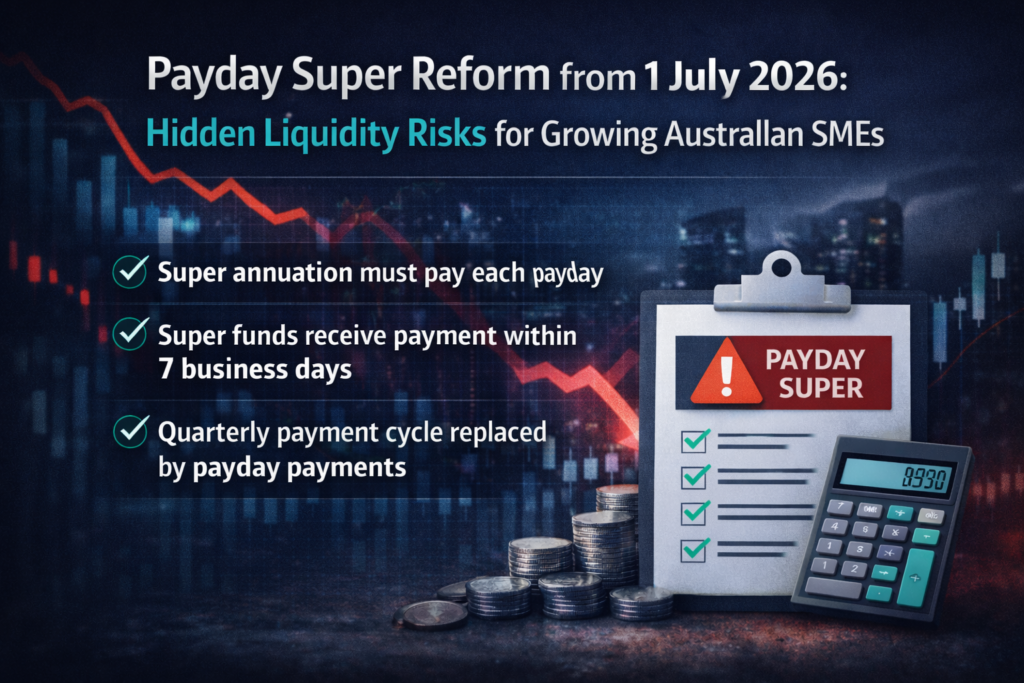
- From 1 July 2026, Payday Super requires employers to pay super at the same time as wages (and generally ensure it reaches the employee’s super fund within 7 business days).
- This removes the old “buffer” many businesses used when paying super less frequently, and shifts the cashflow hit to every payroll run.
- If your customers pay you in 14–60 days, but you pay wages and super weekly/fortnightly, you have a structural timing mismatch.
- That mismatch is a working capital issue, not a bookkeeping issue.
- Use the Payday Super Calculator to quantify the impact and plan funding early.
Run the Payday Super Calculator
Definition: What Is Payday Super?
Payday Super is a regulatory change starting 1 July 2026 that requires employers to pay Superannuation Guarantee (SG) contributions at the same time as they pay wages and salaries. In most cases, the contribution must be received by the employee’s super fund within 7 business days after payday.
Practical meaning: super becomes a pay-cycle cashflow event, not a quarterly admin task.
The New Timing Mismatch That Breaks Cashflow
SME cashflow breaks when outflows happen faster than inflows.
- Outflows: Wages plus super leave your account every pay cycle.
- Inflows: Customers often pay later (14, 30, 45, 60 days).
Payday Super moves super closer to the wage payment date, which tightens the cash conversion cycle. If you are a B2B business offering trade terms, this increases the need for structured working capital.
Real Example Numbers: What Changes Under Payday Super
Example business: a growing services SME with 12 employees.
- Payroll frequency: fortnightly
- Gross wages per fortnight: $42,000
- Super rate (illustrative): 11.5%
- Super per fortnight: $42,000 × 11.5% = $4,830
- Customer payment terms: average 35 days
Under Payday Super, you must fund an extra $4,830 in cash outflow every fortnight (and ensure it lands at the super fund within the required timeframe). That is $9,660 per month of payroll-linked super cashflow impact.
If your average customer pays in 35 days, you are effectively bridging payroll + super for over a month before cash arrives. As payroll grows, the required cash bridge grows automatically.
Growth effect: if wages increase from $42,000 to $55,000 per fortnight, super becomes:
- $55,000 × 11.5% = $6,325 per fortnight
- That is $12,650 per month of recurring super outflow linked to payroll timing.
This is why profitable businesses still feel cash pressure: profit is an accounting measure; payroll timing is a liquidity reality.
What Payday Super Changes Operationally
- Cashflow urgency increases: the super cash hit aligns with each payrun.
- Forecasting must tighten: super is no longer a quarter-end event; it is a pay-cycle obligation.
- Process and systems matter: payroll, clearing houses, and payment workflows need fewer failure points.
- Working capital design matters more: employer businesses with trade terms can require revolving facilities to smooth timing gaps.
Early Warning Signs Your Business Will Struggle With Payday Super
- You rely on “lumpy” inflows (project milestones, seasonal revenue, irregular receivables).
- Your customers pay on 30–60 day terms but wages go out weekly/fortnightly.
- Payroll has grown faster than your cash reserves over the last 6–12 months.
- You routinely use overdraft, director funding, or short-term credit to cover payruns.
- Your finance structure was set up for a smaller business and never upgraded.
If these apply, Payday Super will amplify existing timing pressure.
How to Prepare: The Practical Sequence
- Step 1: Quantify the pay-cycle cash impact of super under your payroll profile.
- Step 2: Compare the super outflow frequency against customer payment terms and cash reserves.
- Step 3: Identify whether your current facility (if any) matches the timing gap.
- Step 4: If needed, structure revolving working capital to smooth pay-cycle obligations.
Use the Payday Super Calculator
Most businesses underestimate the working capital impact because they think in quarterly obligations rather than pay-cycle cash timing. Stress-test it directly:
Try the Payday Super Calculator
Use it to model your payroll, super frequency impact, and the cash buffer required to avoid a pay-cycle squeeze.
FAQ: Payday Super and Employer Cashflow
When does Payday Super start?
Payday Super starts from 1 July 2026. Employers must pay super at the same time as wages and generally ensure it is received by the employee’s fund within 7 business days after payday.
Does this change how often I must pay super?
Yes. It changes super from being commonly handled as a periodic obligation to a pay-cycle obligation aligned to wages.
Why does this create a working capital problem?
Because wages and super must be paid now, while customer receipts often arrive later. If the timing gap is not funded by cash reserves or a revolving facility, liquidity strain increases.
What types of businesses are most exposed?
Payroll-heavy businesses with trade terms, especially hospitality, construction, healthcare, labour-hire, and service firms where customers pay 30–60 days.
What is the fastest way to assess impact?
Model it with your payroll and payment terms. Use the Payday Super Calculator to quantify the pay-cycle cash effect and identify whether facility structure needs review.
For Accountants, Bookkeepers, and Advisors
Payday Super creates a predictable advisory trigger: employer clients who were previously “fine” under less frequent funding habits may face a recurring pay-cycle squeeze.
GPS Finance Group works with referral partners to:
- Quantify the cash timing impact using the Payday Super Calculator
- Identify employer clients most exposed to pay-cycle liquidity compression
- Structure revolving working capital facilities aligned to payroll timing
- Reduce reactive ATO stress cycles by strengthening liquidity earlier
Apply to Become a GPS Finance Referral Partner
Next Step
Run the Payday Super Calculator
Advisors: Join the GPS Finance Referral Program